


The History of Coffee Brewing Methods
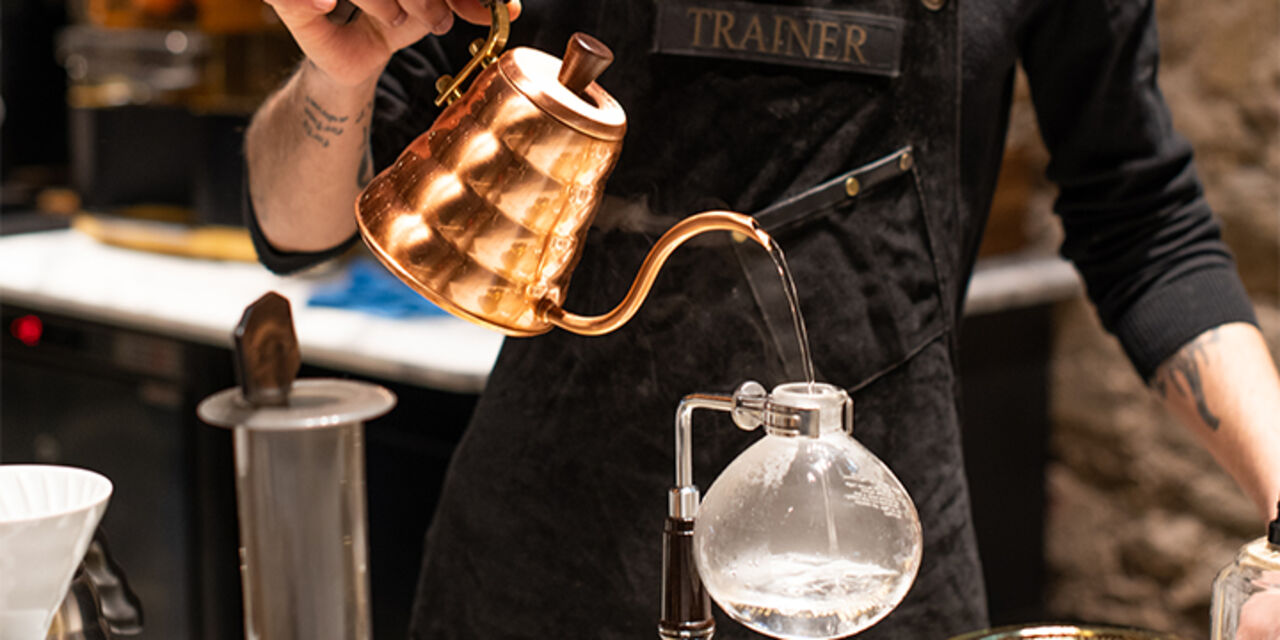
For centuries, coffee has been an essential part of our daily lives, delighting our palates through a variety of brewing methods from past to present — and it continues to do so today. The brewing technique and the equipment used have a significant impact on the flavor of the coffee. As Espressolab, we wanted to take a brief look at the history of coffee brewing methods.
A Brief Look at Coffee Brewing Methods:
THE JOURNEY BEGINNING WITH TURKISH COFFEE
The world’s very first coffee brewing technique is known as “Turkish Coffee.”
There are two stories about how coffee was first introduced to the Ottoman Empire. The first dates back to 1554, when Hukm from Aleppo and Şems from Damascus brought Turkish coffee to İstanbul. They opened a shop in Tahtakale and began selling coffee. This shop went down in history as the first known coffeehouse in the world. Over time, coffee became an indispensable part of palace kitchens and households throughout the Ottoman Empire.
According to the second story, in 1517, Özdemir Pasha, then the Governor of Yemen, brought coffee to İstanbul after becoming enamored with its flavor. Thanks to Özdemir Pasha, coffee from Yemen was introduced to the Ottoman Palace.
Turkish coffee, which held an important place in Ottoman lands, crossed borders into Europe through Venetian traders in 1615 and Marseillaise traders in 1650.
However, the real reason Turkish coffee took root in Europe was the Siege of Vienna. The Austrians first encountered coffee in 1683, during the Ottoman army’s siege of Vienna. As the Ottoman forces retreated, they left behind around 500 sacks of coffee at the gates of Vienna. At first, Viennese soldiers mistook the sacks for camel feed and planned to dump them into the Danube. But an Austrian spy named George Kolschitzki, who was well acquainted with Turkish culture, recognized their value and opened a coffeehouse in Vienna using these beans. This marked the beginning of Turkish coffee culture’s rapid spread across the West, where it gained a prominent place.
In those early days, Turkish coffee was prepared by roasting raw beans, pounding them finely in mortars, and then brewing them in cezve pots over coal or wood fire before serving. The roasting degree, the brewing process, and the amount of water used shaped Turkish coffee into the form we enjoy today. Unlike other brewing methods, Turkish coffee involves no filtering. During brewing, the coffee is brought to a boil several times to achieve its distinctive taste and texture.
POUR OVER
One of the drip coffee methods—also known as drip brewing, filtered coffee, or pour over—has been popular since the early 1900s. With the rise of specialty coffee, it has gained even more prominence. At its core, this method involves pouring water at a specific temperature and over a set period of time in a circular motion over the coffee grounds. It is the most expressive form of the “dance” between the barista and the coffee. This method requires professionalism and a deep understanding of the coffee itself. With a single coffee, it is possible to create more than ten different brewing profiles, each bringing out distinct flavors. It’s a brewing technique that allows the true structure and character of the beans to shine.
ESPRESSO
Around 1901, with the Industrial Revolution in Europe, the first version of the espresso machine was invented—though it looked quite different from the machines we know today.
The original concept of espresso was to make a coffee that could be prepared quickly; in fact, the word “espresso” comes from the term “express.” Milanese inventor Luigi Bezzera, after years of work, succeeded in creating the first espresso machine. In 1947, Gaggia’s invention of the spring piston laid the foundation for the modern espresso machine. In the 1960s, Italian engineer Carlo Ernesto Valente developed the E61 model. This machine replaced the spring piston with an automatic pump system, achieving 9 bars of pressure, which is essential for a proper espresso. Today, home espresso machines typically operate at a constant 9-bar pressure, while more professional machines can go up to 15 bars.
SYPHON
The syphon was invented in Berlin in the 1930s by Loeff. It consists of a two-chamber system that relies on heat. Essentially, steam pressure pushes the heated water from the lower chamber into the upper chamber, where the coffee grounds are located, and the brewing takes place there. Compared to other brewing methods, the syphon produces coffee at a higher temperature, resulting in a brew that extracts more of the bitter compounds. After its invention in Europe, the syphon spread to America and then to Japan, becoming widely appreciated across different cultures.
FRENCH PRESS
The French press is both one of the most classic brewing methods and one of the most widely used pieces of equipment for making filter coffee worldwide. Although the first patent was filed by Italians in 1932, the French had already been using it frequently since the mid-1800s. Its structure is very simple: It consists of a glass container and a plunger with a metal filter at the end, which separates the brewed coffee from the grounds. The recommended brewing time is a minimum of 4 minutes, and the coffee should be ground slightly coarser than for regular filter coffee. If the coffee remains in contact with the water for too long, it may develop bitter flavors, so it's important to separate the brewed coffee from the grounds after about 4 minutes. This method allows the natural oils of the coffee to remain in your cup, resulting in a rich and full-bodied texture.
MOKA POT
What is a Moka Pot?
Bialetti, an Italian company founded in the early 1900s, was known for producing simple and practical kitchenware. In 1933, Alfonso Bialetti invented the iconic Moka Pot Express. Made of cast aluminum with its octagonal lower chamber, filter, and upper pot, the Moka Pot Express has won multiple design awards for its elegant yet simple structure.
The Moka Pot is a stovetop brewer that uses steam pressure of about 2.5–3 bars to brew coffee, producing a cup that is the closest in taste to espresso among non-espresso methods.
CHEMEX
The Chemex was invented in 1941 by German Dr. Peter Schlumbohm. Dr. Peter Schlumbohm was an inventor who held nearly 300 patents. The Chemex was selected by MoMA as the best design of 1943 and was also named one of the top 100 modern designs by the Illinois Institute of Technology.
There are a few key points to keep in mind when brewing with a Chemex: First, the point where the filter paper drains should be quite small. This allows the coffee to brew slowly, extending the contact time between the coffee and the water. You should grind your coffee coarser for filter coffee but finer for French press. Another important factor is using a timer during brewing. A timer will always guide and correct you.
The most important rule of the Chemex brewing technique is the 2 minutes and 30 seconds rule. If you stick to this rule, you minimize your margin of error. Start your timer the moment the water comes into contact with the coffee, and stop it when the water has completely passed through the grounds. The result will help you adjust the coffee grind size. If the brewing time exceeds 2 minutes and 30 seconds, grind the coffee a bit coarser; if it’s shorter, grind it a bit finer.
AEROPRESS
The Aeropress brewing method was invented by American toy designer Alan Adler in 2005. The Aeropress allows you to brew coffee using pressure. A pressure of 2–3 bars is sufficient for brewing. This method results in a more intense aroma. Additionally, because the brewing process is quick, the resulting coffee has low acidity and bitterness, making it smooth and easy to drink.